Are Potatoes Good for Weight Loss? The Surprising Truth That Changes Everything
Potatoes have one of the worst reputations in the dieting world. They’re often lumped in with junk food, blamed for weight gain, and cut from weight loss plans entirely. But if you’ve been avoiding potatoes while trying to lose weight, you might be missing out on one of the most filling, nutritious, and surprisingly weight-loss-friendly foods available.
So are potatoes good for weight loss? The honest, research-backed answer is: yes, but it depends entirely on how you prepare them and how much you eat. A plain baked potato is one of the most satiating foods ever measured by scientists. A plate of French fries or loaded mashed potatoes loaded with butter and cream is not.
In this complete guide, we break down the science, settle the debate once and for all, and show you exactly how to eat potatoes in a way that genuinely supports your weight loss goals.
Also read Is cabbage good for weight loss?
The Surprising Nutritional Profile of Potatoes
Before answering whether potatoes are good for weight loss in detail, let’s look at what a plain potato actually contains — because most people are genuinely surprised.
Plain Medium Baked Potato (150g) Nutrition Facts
| Nutrient | Amount | % Daily Value |
| Calories | 130 kcal | 7% |
| Carbohydrates | 30g | 11% |
| Dietary fiber | 3.3g | 12% |
| Protein | 3.5g | 7% |
| Fat | 0.1g | 0% |
| Vitamin C | 12mg | 13% |
| Potassium | 926mg | 20% |
| Vitamin B6 | 0.4mg | 22% |
| Folate | 38mcg | 10% |
| Magnesium | 30mg | 7% |
| Iron | 1.6mg | 9% |
| Water content | ~78% | — |
At 130 calories for a medium potato — with zero fat, meaningful protein for a vegetable, and significant fiber — the plain potato is a far healthier food than its reputation suggests. The question of whether potatoes are good for weight loss becomes much easier to answer when you look at these numbers objectively.
The problem is rarely the potato itself. It’s what people do to the potato.
Are Potatoes Good for Weight Loss? What the Research Actually Says
The science on this question is genuinely interesting — and strongly suggests that plain potatoes are not only compatible with weight loss, but can actively support it.
The Satiety Index: Potatoes Are the Most Filling Food Tested
This is the most important piece of research for understanding whether potatoes are good for weight loss — and it comes from a landmark 1995 study by researcher Susanne Holt at the University of Sydney.
Holt measured the Satiety Index of 38 common foods — how full each food made participants feel per calorie consumed over 2 hours. Participants ate 240-calorie portions of each food and reported their hunger every 15 minutes.
The result was stunning:
Boiled potatoes scored 323 on the satiety index — the highest score of any food tested. The benchmark food (white bread) scored 100. Potatoes were more than three times as filling per calorie as white bread.
For comparison:
| Food | Satiety Index Score |
| Boiled potatoes | 323 |
| Ling fish | 225 |
| Porridge/oatmeal | 209 |
| Oranges | 202 |
| Apples | 197 |
| Brown pasta | 188 |
| Steak | 176 |
| Whole-grain bread | 157 |
| Popcorn | 154 |
| White bread (benchmark) | 100 |
| Croissant | 47 |
This research directly supports the case that potatoes are good for weight loss, because the most important factor in sustainable weight loss is eating foods that satisfy hunger effectively, making it easier to maintain a calorie deficit without feeling deprived.
Resistant Starch: The Cooling Transformation
Here’s something that genuinely changes the nutritional profile of potatoes for weight loss — and most people don’t know about it.
When you cook a potato and then allow it to cool, the starch undergoes a transformation called retrogradation. The digestible starch partially converts to resistant starch — a type of carbohydrate that behaves more like fiber than regular starch.
Why resistant starch matters for weight loss:
- It is not digested in the small intestine — it doesn’t raise blood sugar or trigger insulin spikes
- It feeds beneficial gut bacteria in the large intestine — improving the microbiome composition linked to healthy weight
- It produces short-chain fatty acids (particularly butyrate) that reduce appetite, improve metabolic health, and support the gut barrier
- Research shows resistant starch specifically increases fat oxidation — the body’s use of stored fat for energy
The practical implication:
Eating cold or reheated potato salad (made with a light dressing) delivers significantly more resistant starch than a freshly baked hot potato — making it an even more weight-loss-friendly option.
A study published in Nutrition & Metabolism found that replacing 5.4% of total carbohydrate intake with resistant starch caused a 20–23% increase in fat oxidation after meals. This is a meaningful metabolic shift — and it directly answers are potatoes good for weight loss with a yes for properly prepared cold potatoes
The Pennsylvania State University Weight Loss Study
A randomized controlled trial conducted at Pennsylvania State University specifically examined whether potatoes could be part of an effective weight loss diet.
Participants were assigned to one of three groups:
- A weight loss diet that included potatoes 5–7 times per week
- A weight loss diet that reduced potatoes
- Control diet
Result: There was no significant difference in weight loss between the potato-eating group and the potato-reduced group. Both lost similar amounts of weight — demonstrating that potatoes in a calorie-controlled diet do not impede weight loss.
The lead researcher concluded that potatoes are a nutritious vegetable that can absolutely be incorporated into a weight loss eating plan — the issue is preparation method and portion size, not the potato itself.
The Problem Isn’t the Potato — It’s What We Do To It
This is the most important concept for understanding whether potatoes are good for weight loss in practice. The potato is innocent. The crime is committed in the kitchen.
Calorie Comparison: Same Potato, Very Different Outcomes
| Preparation | Calories (150g potato) | Fat | Why It Changes |
| Plain boiled | 116 kcal | 0.1g | No additions |
| Plain baked | 130 kcal | 0.1g | No additions |
| Microwaved | 130 kcal | 0.1g | No additions |
| Potato salad (light) | 160–180 kcal | 4g | Minimal dressing |
| Mashed (butter + milk) | 210–250 kcal | 8–12g | Fat additions |
| Loaded baked potato | 400–600 kcal | 20–30g | Sour cream, cheese, bacon |
| Roasted with olive oil | 200 kcal | 8g | Oil addition |
| French fries (fast food) | 450–600 kcal | 22–30g | Deep frying |
| Potato chips (small bag) | 520–600 kcal | 30–35g | Frying + oil absorption |
The plain potato at 116–130 calories becomes a 520-calorie problem when turned into chips — not because of anything the potato does, but because of the preparation.
Why Potatoes Specifically Support Weight Loss
Beyond satiety, there are several additional reasons why the answer to are potatoes good for weight loss is genuinely yes:
1. Potassium Reduces Water Retention
A medium potato provides approximately 926mg of potassium — 20% of the daily recommended value. Potassium is the primary electrolyte that counteracts sodium’s water-retaining effects.
When potassium intake is adequate, the body excretes excess sodium through the kidneys, and the water retained with that sodium follows. For people whose “weight” includes significant water retention from high sodium intake, increasing potassium through foods like potatoes can produce visible, rapid improvements in appearance and scale weight.
Potatoes provide more potassium than bananas, which are famous for their potassium content.
2. Vitamin B6 Supports Protein Metabolism
Potatoes are an excellent source of vitamin B6 — providing 22% of the daily value per medium potato. Vitamin B6 is essential for amino acid metabolism — the processing and utilization of dietary protein.
Adequate protein metabolism is critical for weight loss because:
- Protein is the most satiating macronutrient
- Preserving muscle during calorie restriction requires efficient protein synthesis
- Muscle mass drives resting metabolic rate — the calories you burn at rest
By supporting protein metabolism, potatoes indirectly support the muscle preservation that keeps metabolism elevated during a weight loss diet.
3. Protease Inhibitor II — A Natural Appetite Suppressant
Potatoes contain a natural compound called Protease Inhibitor II (PI2) — a protein that has demonstrated appetite-suppressing effects in research.
PI2 works by:
- Stimulating the release of cholecystokinin (CCK) — a powerful satiety hormone
- Inhibiting trypsin — a digestive enzyme — which extends the digestion of proteins and prolongs fullness
Research published in Cell found that PI2 activated neurons in the brain associated with satiety — suggesting it has direct central nervous system effects on hunger regulation beyond just its digestive actions.
This natural appetite-suppressing compound makes potatoes even more appropriate as a weight loss food — and further explains their remarkable satiety index score.
4. Low Fat Content — Zero Negative Fat Contribution
Plain potatoes contain virtually no fat — just 0.1g per 150g serving. Fat has 9 calories per gram (compared to 4 for carbohydrates and protein) — so fat-free foods have significantly lower calorie density than fatty alternatives.
The concern about potatoes causing weight gain comes almost entirely from the fats added during preparation — butter, cream, sour cream, cheese, and frying oils. Remove these additions, and potatoes become an extremely low-fat, moderate-calorie food entirely compatible with weight loss.
5. Genuine Nutrient Density Supports Overall Health During Calorie Restriction
During calorie restriction, getting adequate micronutrients becomes more challenging — you’re eating less food overall. Nutrient-dense foods that provide significant vitamins and minerals per calorie are particularly valuable during weight loss.
Potatoes provide:
- Vitamin C (immune function, fat metabolism support)
- Potassium (fluid balance, cardiovascular health)
- B6 (protein metabolism, neurotransmitter production)
- Folate (DNA synthesis, cardiovascular health)
- Iron (oxygen transport, energy metabolism)
- Magnesium (insulin function, hundreds of enzymatic reactions)
This nutrient density makes potatoes a valuable part of a weight loss diet — not just a source of empty carbohydrates.
The Glycemic Index Debate: Is It Actually a Problem?
One of the primary reasons potatoes are excluded from weight-loss diets is their high glycemic index (GI). White potatoes have a GI of approximately 78–82, classified as high. This leads many dieters to avoid them, fearing blood sugar spikes.
Why the GI concern is often overstated:
Glycemic Load matters more than Glycemic Index:
Glycemic load (GL) accounts for how much of a food you actually eat. A typical 150g potato serving has a GL of approximately 14–17, considered moderate, not high.
Preparation dramatically affects GI:
| Potato Preparation | Glycemic Index |
| Boiled (hot) | 78 |
| Boiled, cooled, eaten cold | 54 (Low!) |
| Baked | 85–111 (highly variable) |
| Steamed | 65 |
| French fries | 63–75 |
| Mashed | 83 |
Cooling cooked potatoes dramatically reduces their glycemic index — from high (78) to low (54) — through the conversion of resistant starch discussed earlier. A cold potato salad has a lower GI than most breads, rice, and pasta.
Context matters:
When potatoes are eaten as part of a mixed meal containing protein, fat, and fiber — as most meals are — the blood sugar response is significantly blunted compared to eating potatoes alone. The GI is measured in isolation; real-world mixed meals produce much more moderate glucose responses.
The Worst Ways to Eat Potatoes for Weight Loss
When cooked incorrectly, are potatoes beneficial for weight loss? Not at all. The following preparations turn a food that is good for weight loss into a calorie bomb:
French fries are the main culprit.
A medium serving of 117g of fast-food French fries has about 365 calories, while a boiled potato of the same weight has 116 calories. The process of frying:
- significantly raises the calorie content by absorbing oil
- GI is higher than that of cooked potatoes.
- adds a lot of trans and saturated fats.
significantly lowers satiety per calorie by reducing the amount of water and fiber in each meal.
Potato chips were the food most significantly linked to weight increase over time, followed by French fries, according to a massive study involving more than 120,000 participants that was published in the New England Journal of Medicine. However, there was no significant correlation found between boiling, baking, or steaming potatoes and weight increase.
Baked potatoes that are loaded
A baked potato with sour cream (60 kcal/tbsp), cheddar cheese (110 kcal/28g), and bacon (43 kcal/strip) increases its calorie content from 130 to 400–600 calories, mostly from fat.
Butter & Cream Mashed Potatoes
Because the fat and cream change the food’s texture and stomach-emptying rate, traditional mashed potatoes made with a lot of butter and full-fat cream can have 250–350 calories per serving, more than twice as much as a plain potato, but they also have significantly lower satiety.
Best Ways to Eat Potatoes for Weight Loss
Are potatoes good for weight loss when prepared correctly? Yes — here’s how to do it:
1. Boil and Cool (Maximum Resistant Starch)
- Boil potatoes in water until tender
- Allow to cool completely — at room temperature or refrigerated
- Eat cold or reheated to lukewarm (reheating doesn’t significantly reduce resistant starch content)
- Season with herbs, vinegar, mustard, and lemon juice
2. Simple Baked Potato with Protein Toppings
- Bake a medium potato at 200°C (400°F) for 45–60 minutes
- Top with cottage cheese, Greek yogurt, salsa, steamed broccoli, or tuna
- Skip the butter, sour cream, and cheese — or use minimal amounts of lower-fat alternatives
3. Cold Potato Salad (Light Dressing)
- Boil and cool potatoes
- Dress with apple cider vinegar + Dijon mustard + herbs + minimal olive oil
- Add cucumber, celery, herbs, and light protein
- Refrigerate — the cooling maximizes resistant starch
4. Steamed Potatoes with Vegetables
- Steam rather than boil (slightly better nutrient retention)
- Serve with roasted vegetables and lean protein
- Season with garlic, herbs, and spices — not butter or oil
5. Air-Fried Potato Wedges
- Cut potatoes into wedges, spray lightly with cooking spray (vs. deep oil frying)
- Season with paprika, garlic powder, and herbs
- Air fry at 200°C for 25 minutes
- Approximately 150 calories per serving vs. 450+ for deep-fried equivalents
Potatoes vs. Other Common Carbohydrate Sources for Weight Loss
| Food | Calories (150g cooked) | Fiber | Protein | Satiety | Weight Loss Suitability |
| Boiled potato | 116 kcal | 2.5g | 2.5g | ⭐⭐⭐⭐⭐ | ⭐⭐⭐⭐ |
| Brown rice | 168 kcal | 1.8g | 3.5g | ⭐⭐⭐ | ⭐⭐⭐ |
| White rice | 195 kcal | 0.4g | 3.6g | ⭐⭐ | ⭐⭐ |
| Whole wheat pasta | 174 kcal | 3.9g | 7.4g | ⭐⭐⭐ | ⭐⭐⭐ |
| White pasta | 220 kcal | 1.8g | 8g | ⭐⭐ | ⭐⭐ |
| Sweet potato | 130 kcal | 3g | 2.4g | ⭐⭐⭐⭐ | ⭐⭐⭐⭐⭐ |
| Quinoa | 185 kcal | 2.8g | 6.7g | ⭐⭐⭐⭐ | ⭐⭐⭐⭐ |
| Oats (cooked) | 150 kcal | 4g | 5.3g | ⭐⭐⭐⭐⭐ | ⭐⭐⭐⭐⭐ |
Boiled potatoes compare very favorably to common carbohydrate sources — particularly in satiety, which is the most important factor for sustainable weight loss.
What About Sweet Potatoes — Are They Better for Weight Loss?
When discussing whether or not potatoes are beneficial for weight loss, it is common to compare sweet and ordinary potatoes.
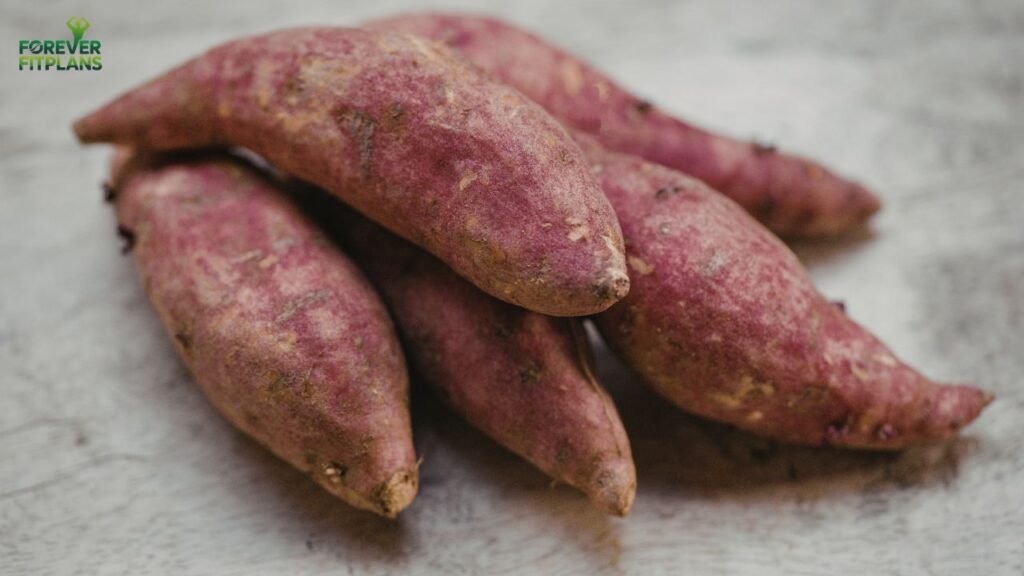
Benefits of sweet potatoes
- Reduced GI (54–70 compared to 78–82 for white potatoes)
- Increased beta-carotene content (which is converted to vitamin A)
- Dessert cravings may be satisfied by natural sweetness.
Benefits of white potatoes
- Increased potassium levels
- Increased levels of potease inhibitor II (stronger study on appetite suppression)
- Higher protein content per serving
- A higher score on the satiety index
- Much more economical
The truthful evaluation: When prepared properly, both are great, nutrient-dense sources of carbohydrates that can aid in weight loss. White potatoes have a substantial satiety advantage, while sweet potatoes have a slight glycemic advantage. The best course of action is to incorporate both into a diversified diet.
Practical Portion Guide for Potatoes During Weight Loss
| Meal Role | Recommended Portion | Calories | Notes |
| Main carbohydrate | 150–200g cooked | 115–155 kcal | Paired with protein and vegetables |
| Side dish | 100–150g cooked | 77–115 kcal | Alongside a protein-heavy main |
| Weight loss meal | 150g + large salad + protein | 300–400 total | Complete balanced meal |
| Maximum daily | 300–400g across meals | 230–310 kcal | Reasonable daily maximum |
Frequently Asked Questions
Are potatoes good for weight loss, even though they have high carbs?
Yes — potatoes are good for weight loss despite their carbohydrate content because they’re uniquely satiating. Research shows boiled potatoes score 323 on the satiety index — the highest of any food tested — meaning they fill you up more per calorie than virtually any other food. When you eat foods that genuinely satisfy hunger, maintaining a calorie deficit becomes much easier. The key is eating them boiled, baked, or steamed without high-fat additions — not fried or loaded with butter and cream.
Should I avoid potatoes when trying to lose weight?
No, you don’t need to avoid potatoes when trying to lose weight. A Pennsylvania State University randomized controlled trial found that people who ate potatoes 5–7 times per week lost the same amount of weight as those who reduced potato consumption. The issue isn’t potatoes — it’s high-calorie preparations like French fries, chips, and loaded baked potatoes. Plain boiled or baked potatoes, eaten in appropriate portions as part of a calorie-controlled diet, are entirely compatible with successful weight loss.
Is a baked potato good for weight loss?
Yes — a plain baked potato is one of the most weight-loss-friendly forms you can eat. At approximately 130 calories for a medium potato with 3.3g of fiber and 3.5g of protein, a plain baked potato is filling, nutrient-dense, and low in fat. The keyword is “plain” — topping it with sour cream (60 kcal/tablespoon), butter, and cheddar cheese transforms it into a 400–600 calorie meal. Use Greek yogurt, salsa, cottage cheese, or steamed vegetables as toppings to keep the baked potato a weight-loss-friendly meal.
Do cold potatoes have fewer calories, and are they better for weight loss? A: Cold potatoes don’t have fewer calories — they contain the same calories as hot potatoes. However, cooling cooked potatoes significantly improves their weight loss properties by converting digestible starch to resistant starch. This reduces the glycemic index from approximately 78 (hot boiled) to 54 (cold boiled) — a low GI. Resistant starch feeds beneficial gut bacteria, doesn’t spike blood sugar, and research shows it increases fat oxidation by 20–23%. Cold potato salad (with a light dressing) is genuinely one of the most weight-loss-optimized ways to eat potatoes.
Are sweet potatoes better than regular potatoes for weight loss? A: Sweet potatoes and regular potatoes are both excellent weight loss foods — each with slightly different advantages. Sweet potatoes have a lower GI (54–70 vs. 78–82) and more beta-carotene. Regular potatoes have more potassium, higher protease inhibitor II (a natural appetite suppressant), a higher satiety index score, and are more affordable. Neither is dramatically superior for weight loss — both are nutritious, filling, and can be part of an effective weight loss diet. The best approach is to include both in a varied diet and focus on the preparation method (boiled, baked, or steamed — not fried) for either type.
How many potatoes can I eat per day for weight loss?
Most people can eat 150–300g of plain cooked potato daily as part of a weight loss diet. At 116–230 calories for this range, it fits comfortably within most calorie-controlled eating plans. The more important factor is what you’re not eating alongside the potato — replacing refined grain products (bread, pasta, white rice) with potatoes while keeping other meal components constant often produces favorable weight loss results because of potatoes’ superior satiety. Focus on preparation method (boiled or baked, not fried), appropriate portion size, and healthy toppings rather than eliminating potatoes from your weight loss diet.
Will eating potatoes every day make me gain weight?
Eating plain potatoes daily does not cause weight gain when they’re consumed as part of a calorie-controlled diet. Research — including a large study of 120,000+ people over 20 years — specifically found that boiled and baked potatoes were NOT associated with weight gain. The same study found that potato chips and French fries were strongly associated with weight gain — demonstrating that preparation method, not the potato itself, determines the weight outcome. Replacing higher-calorie, lower-satiety foods with plain potatoes can actually support weight loss by reducing overall calorie intake while maintaining greater satisfaction.
Conclusion
The answer to the question of whether potatoes are beneficial for weight reduction is unquestionably yes, with one crucial caveat: preparation technique is crucial. This conclusion is based on a study of all the information, including satiety research, resistant starch science, clinical weight loss trials, and nutritional data.
Simple preparations of potatoes, such as boiling, baking, steaming, or eating cold, are among the most satisfying, nutrient-dense, and weight-loss-friendly foods. Compared to nearly every other food examined, they provide you with more energy per calorie. They have a naturally occurring substance that suppresses hunger. They include great fiber, potassium, vitamin C, and vitamin B6. They produce resistant starch when chilled, which boosts fat burning and nourishes good gut flora.
When made into chips or covered in butter, are potatoes beneficial for weight loss? Not at all. However, that is not a potato issue; rather, it is a culinary issue.
There is no need to exclude potatoes from your weight loss regimen, according to the overwhelming evidence. The way you prepare them needs to be reconsidered. Use boiled potatoes instead of French fries. Greek yogurt can be used in place of the sour cream. Make a light vinegar dressing for a cold potato salad. Instead of frying, bake.
Are you prepared to try potatoes again? This week, prepare a straightforward chilled potato salad with fresh herbs and an apple cider vinegar dressing. Consume it with veggies and lean protein at a meal. Observe your level of fullness and how long it lasts. The research on satiety is correct. When cooked properly, potatoes are one of your greatest allies in the battle against hunger when following a diet for weight loss.
You can also read more inforamation from health.

Dr. Daniel Carter is a certified health & wellness writer and fitness lifestyle researcher with over 8 years of experience in nutrition, weight management, sleep health, and preventive care. He is passionate about helping people live healthier, stronger, and more balanced lives through science-backed fitness strategies and easy-to-follow wellness tips.
Through FitForever Plan, Dr. Carter shares practical health advice, workout guidance, and nutrition insights designed to support long-term fitness, sustainable weight loss, and overall well-being. His mission is to make healthy living simple, achievable, and enjoyable for everyone.